Article209

BITCOIN

Federal Reserve & Commodities

FOMC Decision of March 18th 2026 (2026-03-19)

As the FOMC met for the second time this year there have been dramatic changes to the economic environment. You may recall that last meeting had been affected in terms of data, hence visibility, by the government shutdown that affected the publication of various prominent statistics. It was expected that by this meeting there would be enough numbers of good quality for participants to properly evaluate the health of the economy. However, the major conflict that errupted just over two weeks ago has muddied the waters to the extent that it is currently impossible to establish a medium term strategy. Market consensus was that the committee would leave rates unchanged and this is exactly what happened.

The Statement

The two main changes in the statement, when compared to January 28th are:

  • The perception that unemployment has "little changed in recent months" as opposed to having "shown some signs of stabilization.
  • The inclusion of the Iran war as a source of uncertainty, "implications of developments in the ME for the US economy are uncertain".

The Press Conference

The war against Iran has shifted the center of gravity from the relationship between Powell and Trump back to the economy. The main topic of course was the price of energy and how it would affect the course of monetary policy. In my view the overall tone was hawkish leaning, there were no explicit comments but there were hints here and there that accomodative monetary policy was not the base case. Overall the presser was really dull. Here are the main take-aways:

  • The standard policy in case of a shock in the price of oil is to "look through" as Powell put it. However he was quick to point out that inflation has been very stubborn over the last year and this could alter the canonical response to the shcok. On the flip side though the Chairman was rather confident tariff induced inflation should dissipate over the next few months.
  • An important analysis shared by Powell is that the labor market is showing signs of stability but it is not in a healthy equilibrium. Under the hood the reduction in job offers that is being felt and is apparent in the numbers is matched by a reduction in the offer of labor as immigration has come to a halt. However, in one of his answers he clearly stated that labor was not more at risk than price stability. This was one the few answers that caused an immediate market spike.
  • Another market moving statement came unsollicited from the Chairman as he explained that until his successor is not officially appointed by the Senate, he will continue in his current role as is traditionnaly the case. However he stated that until the DoJ probe is ongoing he will not resign from the Board of Governors, in this case, contrary to tradition. This of course would not allow Trump to name a new governor. If the market was anticipating that part of future rate reductions were just political, this could have shaved a good chunk of this estimate.
  • The main message that contributed to the dullness cited above and shut the door to any meaningful analysis, was that uncertainty was at an extremely high level. The committee hopes that over the next 6 weeks that separate us from the next FOMC meeting there will be a lot more clarity. Powell even went as far as to argue that the SEP was a very delicate exercise and ideally the committee should have skipeed it.

The message most of market participants understood, including myself, is that the new upside risks to inflation caused by the conflict in the ME have balanced the dual mandate risks. If the committee was slightly more concern with the labor market at the end of last year, the situation is now different and a rebound of inflation is equally feared.

The Market Reaction

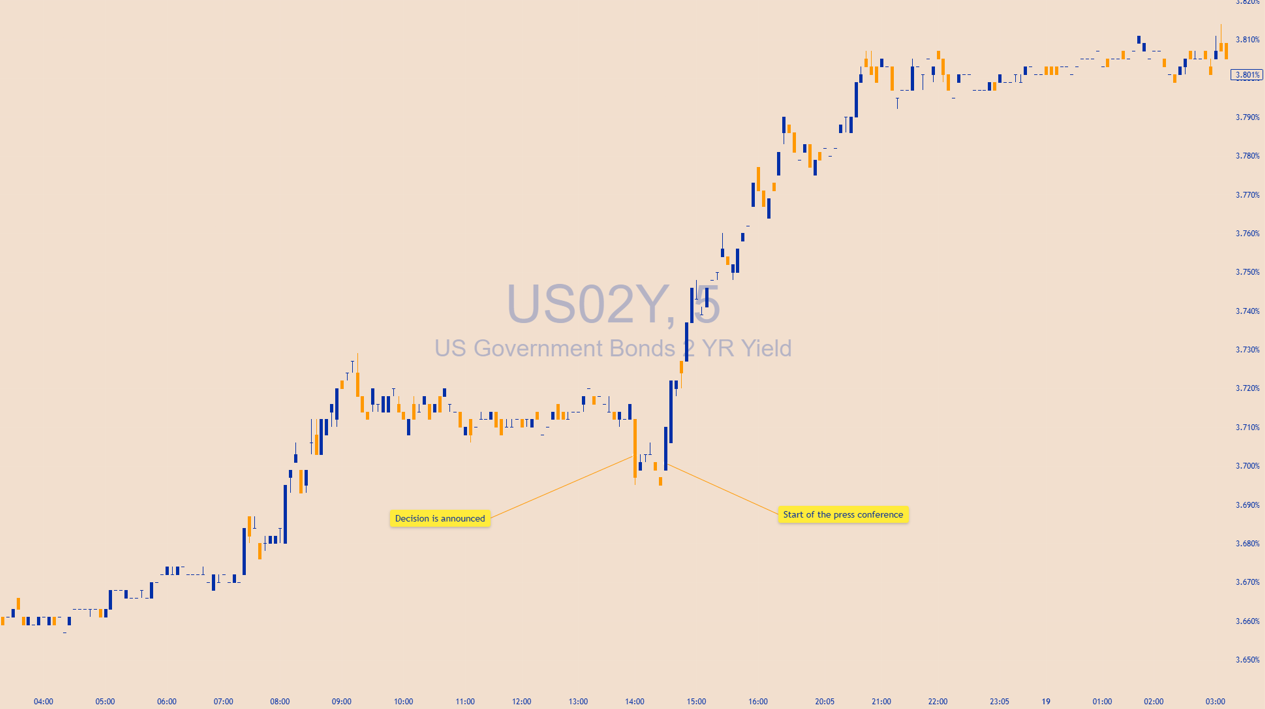
Market reaction was very clear. It is not unusual for the market to have a whipsaw behaviour during the press conference with robots oscillating between hawkish or dovish reads. Yesterday was a one-way street up. The annoucement confirmed market expectations and the wording of the statement was neutral. This could have been seen as slightly dovish from participants as some could have expected stronger wording related to the potential consequences of the conflict in the Middle-East.

5m chart of the US 2y treasury rate

However, as soon as the press conference was underway the tone was set and the 2y rate never looked back... In the 5 minutes candle graph above we can see the 10 basis points move from roughkly 3.70% to 3.80% during the end of the session.

What to expect?

The market interpreted the decision unambiguously. I would argue that we could see a mini trend over the next few days if the conflict with Iran doesn't show signs of easing. It is going to be difficult, even for, those who strognly favored a rate cut prior to this eeting to advocate strongly in this direction. The labor market would have to give very ominous signs to tilt the balance in the direction of a cut while price shock uncertainty is at its highest. The fact that Powell has decided to stay at the board as long as it takes him to settle his legal affairs is also another hawkish element. We bitcoiners will have to wait a bit longer for the monetary relief that could lift the price up again to previous trading ranges.

FOMC Preview (2026-03-17)

The FOMC meeting is underway. The decision on the future path of monetary policy will be announced tomorrow at 2pm. Here are some elements to prepare for it:

  • The federal funds rate target range is currently 3.50 - 3.75 percent p.a.
  • The minutes of the last meeting show that participants deemed inflation elevated still but its causes (tariffs mostly and housing) were dissipating. On the other hand, despite an optimistic view on the jobs market, it was still showing mixed signs.
  • Since the last meeting we have had some mixed numbers. On the inflation from the last CPI report shows headline inflation running at 2.4% and core CPI inflation at 2.5% on a year to year comparison. The PCE numbers reported last week stood at 2.8% and 3.1% for headline and core respectively, YoY. On the jobs side the last NFPR surprised on the downside, posting a negative 92k while the market was expecting a positive 65k jobs added to the economy. Unemployment inched up to 4.4% from 4.3%. GDP for the last quarter of 2025 was heavily affected by the Government shutdown and should not influence the FOMC members.
  • Of course the main development since the last meeting has been the conflict in the Gulf. The events have generated a spike in the price of oil and greater overall uncertainty. The main focus now is on the Strait of Hormuz where limited circulation for a prolonged period could leave the barril of oil above USD 100. Since the start of the conflict the US Treasury 2 year rate has gone from 2.50 to 2.70 percent.
  • In this context and given the already previous neutral stance by the FED a cut is completely off the table. The participants will probably reinforce their data dependency mode and leave it at that. There should be little movement when the decision is announced. Greater volatility could be observed when Powell speaks afterwards. If he were to surprise us I think it could come from more hawkish than expected comments regarding the way the war is being factored in by the FED.
  • From a bitcoiner perspective I don't expect tomorrow's meeting to have a large impact. The Iran developments are the main drivers of price right now and we have seen the price of bitcoin hold up relatively well compared to other assets. We would need something out of the blue, such as a very targeted comment, for a fall back the 65k handle.

What are the chains holding back BTC? (2026-02-10)

Over the last 10 days bitcoin has broken down from a previous trading range that sat between USD 85k and USD 95k. The first significant candle came on Thursday January 29th, the day GLD lost 7 percent in 25 minutes and SLV plunged to USD 98 from USD 110 in an hour, dragging equities and BTC with them. Interestingly both metals and equities bounced back while bitcoin kept trading near the lows of the day.

On the next day we had the big silver and gold flush-down and over the next days bitcoin moved in lock-step either with the metals market either with the equity market, but always on the way down. The equity market suffered a mini-meltdown on fears the software industry would be quickly eaten up by AI and firms like CRM, ADBE for example were going to face enormous hardship.

After touching USD 60k bitcoin finally bounced back with energy. It also coincided with a major equity pull-back, which helped some. It is now trading close to USD 70k and as markets enter a wait and see mode that typically precedes to the jobs report scheduled for this Wednesday, there seems to be some stabilization.

It is now clear that bitcoin is in a structurally weaker position when compared to other assets that are normally correlated with it. Before the current melt-down it had failed to go up with equities, which are close to ATH, and failed to move in tandem with gold, itself on a parabolic move. On the flip side, after the correction, it also showed much less enthusiasm on the way back. In search of possible explanations I decided to go through the main issues bitcoin is facing. I list them below in random order so don't infer any information from the way topics are structured. I only mention the factors that in theory should not affect the other main asset classes. For example the Kevin Warsh nomination is said to have played a role in the leg down that followed the news (I don't believe in this argument because rates were vey little changed), but this development also impacts gold and equities. So let's take a look at these idiosyncratic factors.

The Quantum Threat

This item has taken a new dimension since Nic Carter published two articles on the subject. He has also been vocal about what he considers a passive stance by the core developers. Most of the voices I heard since then have been reassuring, placing the required advances in quantum computing ten years from now and, above all, confirming that quantum proof signatures could be rolled out rapidly. These are estimates of course so even if we can safely rule out major threats within one or two years, maybe 5 years is in play... Despite the general feeling that this topic is not really tangible at the moment for bitcoin, markets, as we know, are a forward discounting machine. Newcomers to bitcoin may be put off by the thought of having to make changes to their setup in the near future and institutionnals are probably being questioned on this topic by their risk teams, with no-one really knowledgeable enough to provide solid answers.

The Epstein Files

It is remarkable to see the breadth of businesses and industries affected by the Epstein files. In the case of the crypto-currency space two headlines have circulated extensively:

  • Epstein was an early investor in Coinbase and Blockstream
  • Epstein had ties with Joy Ito, the boss of the MIT Media Lab that funded some Bitcoin Core developers. USD 800k was channeled to the lab via Epstein. Epstein also discussed some topics with Adam Back.
The first item is anecdotical at first sight but the second is potentially damaging. Of course bitcoiners familiar with the inner workings of Bitcoin know that even if one convinces enough Bitcoin Core developers to make malicious changes, these will always have to go through the scrutiny of the community and alternative softwares could rapidly emerge. However, for a good amount of market participants who don't know how the protocols are implemented, it sounds as though bitcoin can be easily corrupted and it may already be part of a "grander scheme".

Gold's Success Story

Much of bitcoin's appeal is that it should function as a hedge against debasement of the fiat currencies. It's nicknamed "digital gold" and its advantages over the metal, such as easy storage, no transportation issues and no need for physical verification of its authenticity, are unarguable.

We are going through a period where the lack of confidence in many government's ability to contain deficits and conduct sound monetary policies is at its highest. Wealth protection is a major issue. The decor has been almost magically set for bitcoin to shine, yet it is gold that does so. And not only is gold fulfilling its role as a hedge against debasement, it is making parabolic moves that were up to now the exclusivity of bitcoin. Many traditional investors that were eventually considering bitcoin as a hedge are now being presented with the proof that gold fulfilled its contract while bitcoin is still a promise. As another example of the speculative shift to metals, the Wall Street Bets group, famous for its crypto friendliness and GME exploits, have silver as one of their prefered bets.

Critical Prices

The analysis of the blockchain produces valuable inputs in terms of levels that can be catalysts for added volatility should they be violated. During the recent leg down some of these prices have been crossed. One of them is the average price of ETF investors. It stood in the low end of the USD 80k range. We are now in a situation where a majority of ETF holders is facing a loss. They are probably less inclined to keep on adding bitcoin to their portfolio. The dip was bought aggressively around USD 60k but will there be a follow-through? It would be interesting to see the price test again this region so we can assess the solidity of this zone in terms of acting as a new floor. Another interesting metric is the MSTR average price. It has also been crossed downwards. Many bitcoiners trust Michael Saylor to have profound knowledge of the market and believe he and his team can trade better than average. The fact that bitcoin is trading below MSTR average price is rather discouraging.

The Tail that Wags the Dog

It is difficult to estimate the daily notional amount of BTC derivatives and spot traded on a daily basis. Only part of the derivatives market is regulated (CME, B3...) and many exchanges don't have the obligation to inform the numbers. Spot trading at the blockchain level is biased because a lot of pure BTC transactions are netted within the exchanges. Despite the lack of accurate figures every market participant feels derivatives instruments are increasingly influencing the price of BTC. It has been said that a lot of large bitcoin holders for example are writing covered calls and the hedging of these positions by the intermediaries is generating a constant downward pressure on the price of the underlying. It is also evident that large moves force massive liquidations of leveraged positions (not necessarily in the form of pure derivatives but akin to) that, in turn, amplify price movements. This can generate loop effects that makes things worse in a sharp downturn.

The 4 Year Cycle

All bitcoiners are aware of the 4 year cycle. It says that after a halving, bitcoin enters a bull market of up to 18 months, which is then followed by a 10 to 12 months bear market. Then a period of accumulation lasts until the next halving. Strangely a lot of die hard bitcoiners are currently dismissing the 4 year cycle, arguing that bitcoin is a much more mature asset class nowadays and that it can no longer follow such a simplistic pattern. However, if you look at the charts the 4 year cycle is very much alive. The 2025 occurred in October, 16 months after the last halving and bitcoin entered bear market territory roughly 17 months after the halving. Despite being dismissed by pundits it could be that this theory is weighing on investor sentiment.

Clarity Act

The drama surrounding the Clarity Act is undeniable. For those who are not following what happens in Washington closely the Clarity Act - which has not been voted yet - is a potential law that will ultimately determine the responsibilities of each regulator with regards to the crypto markets, and how these are defined in terms of asset classes. It aims at clarifying a few gray zones that exist today. Despite the fact that stablecoins were not the main issue here, the banking industry is trying to make it impossible for anyone in the crypto space to offer a yield on stablecoins. This has derailed the talks and the crypto industry has decided to withhold its support for the moment. Brian Armstrong, who embodies the resistance against the banking industry is facing enormous pressures from the establishment. It is not far fetched to imagine that TradFi, who know controls quite a large chunk of the bitcoin market through ETF, derivatives etc is not going to pump up the price of bitcoin while fighting Coinbase and other large crypto players. This is just speculation of course. However it is not unreasonable to think that for most institutional investors the lack of progress in terms of legislation could be seen as a setback and generates a risk-off sentiment.

Digital Treasury Companies

The amount of bitcoins bought by the companies that either decided to become pure bitcoin treasuries or would start investing part of their liquidity in bitcoins is very large. The success of MSTR has spurred an enormous amount of disciples. It is very hard to keep track of the new companies that enter the market with a Strategy playbook or simply decide to transform a moribund business into a crypto venture. The amount of bitcoins held by these companies is estimated at 6 percent of total supply. Some companies are still buying the dips religiously but most of them have suffered severe blows and are operating below MNAV (meaning that the market value of the company is lower than the amount of bitcoins they hold). The constant influx has dried up and this is certainly a reason why bitcoin has lacked vigor over the last couple of months.


All this seems rather grim, but when you have studied the markets long enough you know that when most of the negative factors that can affect an asset are impacting its valuation the path of least resistance is on the way up. We can safely bet that if there is a break-through on the discussions around the Clarity Act, if the core development team announces that it will start working on a quantum resistant version, if deleveraging has gone far enough, we should see a bounce back to the mid to upper seventies.
Kevin Warsh chosen By D. Trump as the next FED Chairman (2026-01-31)

A few analysts were expecting Trump to announce his pick for FED chair during the Powell presser that followed the FOMC rates decision on Wednesday but he may have thought that the bond market's sense of humor is different from that of the majority... The name in the end was not a surprise. Rieder, who resurfaced as a strong contender after the encounter between Fink and Trump in Davos, would have generated much more noise and astonishment. The MSM is insisting that his nomination is not a given, but I expect it to go through rather smoothly.

Warsh is clearly aligned with the short term views of the current administration and I guess Trump sees him as one of the most loyal of the potential contenders. In Davos Trump was explicit about the risks he faced in choosing the next Chairman: "they change once they get the job...". Warsh is probably seen by Trump as less likely than Rieder to soon pivot. I guess Miran and Waller were seen as aligned with Trump too, Miran more so than Waller I guess, but both seem to be fulfilling their role pretty well and changes always come with some risks.

Here are some elements to gain some familiarity with Warsh:

  • Warsh is not a trained economist like Bernanke or Yellen. He studied Public Policy at Stanford and then went on to obtain a law degree from Harvard. His academic credentials are immaculate but one can safely bet he didn't spend much time calibrating DSGE models...
  • Warsh however has some serious hands-on experience in the markets and with macro policy. He spent four years, from 2002 to 2006 at the National Economic Council. In 2006 Bush nominated him as FED Governor, making him the youngest ever, at 35, to fulfill this role. After resigning from the FED in 2011 as the result of his oppposing views on FED policies, he worked mostly in academia and with Druckenmiller at Duquesnes.
  • Both of them were from an early stage very critical of QE. As an example, here is a 2014 oped for the WSJ denouncing the now called K-shaped economy, blaming the FED for it and arguing for an end to QE. The last three paragraphs encapsulate the thesis, (WSJ article). Druckenmiller is also very close to Bessent. It is reported that this played a large role in the choice of Warsh.
  • As a result of his past stance with regards to QE, Warsh has been categorized as a hawk, a label downplayed recently during his campaign for the nomination. He did have strong views at the time and it will be interesting to see how he accomodates a more dovish stance in the short run with his prior comments on how the FED should run its policy.
  • Warsh is married to an Estee Lauder heiress, the daughter of Ronald Lauder, a GOP benefactor and a previous US Ambassador in Austria. Given his pedigree, his ties to Wall Street and the academic circles he navigates in, Warsh is completely aligned with the establishment. It is very hard to imagine that he will not engage in some type of heterodox market rescue if TradFi players suddenly face some sort of acute adverse scenario.

The market reaction to his name was quite muted. The metals sell-off in my view has nothing to do with Warsh and was already in the making on Thursday. The large drop in siver and gold on Thursday, where gold for example lost 7 percent in 25 minutes (CET 10:00) was a red signal for a lot of investors. Given the sizeable profits generated over the last few months with silver and gold, a lot of investors must have felt that it was safer to take some chips off the table and avoid seeing their profits cut by half in a couple of days. Neither short nor long term rates moved on Warsh's news. His current Trump induced dovishness coupled with his previous views on the role of the FED probably netted themselves out.

I don't expect Warsh to bring about some radical changes in how the FED operates. It is said that he is strongly opinionated and he may try to put his stamp of the FED by altering the communications framework or compliance standards. But we shouldn't expect any radical policy shift. In the face of strong adversity Warsh may have to acknowledge that the FED is the only game in town, as Bernanke is reportedly said to have once told him, arguing for QE.

FOMC Rate Decision of January 28th 2026.

On the first meeting of 2026 the FOMC kept its target range for the federal funds rate at 3.50 / 3.75 percent. Two members dissented, Miran favored a 50bps cut while Waller desired a 25bps cut. this decision was widely expected by the market, trading at 99 percent on Kalshi and 96 percent on Polymarket.

The Statement

The most notable change in the statement came in the first paragraph where the mention of a declining labor market was substituted by "the unemployment rate has shown some signs of stabilization". This is the justification for the pause in the easing cycle. The deterioration has stopped and the FED will, from now on, "carefully assess incoming data, the evolving outlook, and the balance of risks"...

The Press Conference

The press conference was rather tense as reporters started questioning Powell about the recent political interference at the FED. He repeatedly told them he had nothing to offer them on the topic... But turning to the important stuff, here are the relevant items that came out of his answers:

  • Consumer spending is strong and this is the economy's current engine. The government shutdown is expected to slow the economy in 2025Q4 but it should bounce back in 2026Q1 with little net impact. The Labor market has stabilized and GDP is strong. With regards to inflation, services and the housing market prices are declining and act as a counterweight to the tariff induced inflation.
  • Rates are deemed by the Committee to sit at the higher part of the neutral range. Economic data doesn't suggest rates are in the restrictive zone.
  • The labour market configuration is very difficult to read in Powell's eyes as the declining supply that resulted from the immigration crackdown has been matched by a decline in demand.
  • As a methodology cue for FED watchers he said GDP figures are quite volatile on a high frequency and he prefers to focus on labor statistics.

Powell normally doesn't comment on variables that are not under the responsibility of the FED. For example, when asked about the weakening of the US dolar at the begining of the press conference, he said this was the responsibility of the Treasury and he would not talk about it. However at some stage he said the current fiscal policy is unambiguously on an untenable trajectory and quickly stated that the Federal debt, however, was still on a sustainable path. The message was quite clear.

The Market Reaction

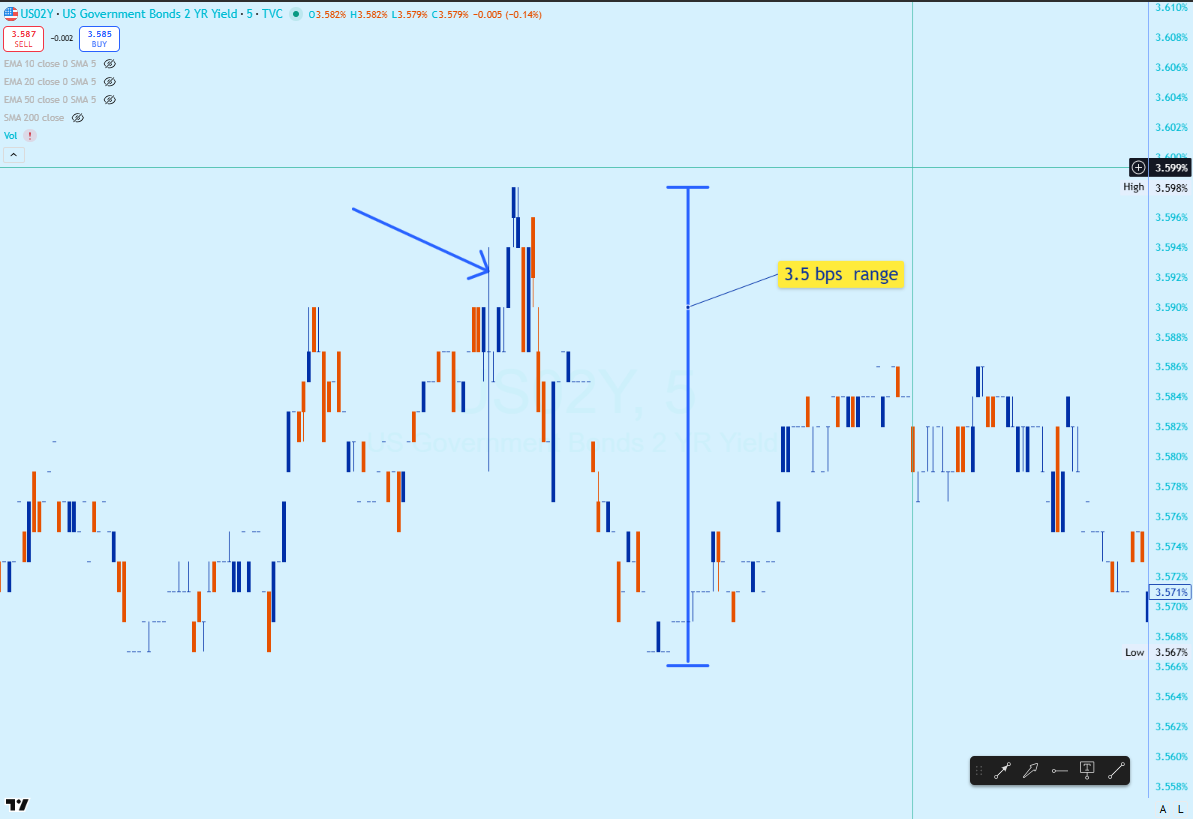
Market reaction was extremely damped. The decision was highly anticipated. I show below the 5mn chart of the 2y treasury rate. The blue arrow points to the candle that was formed during the FOMC announcement.

5m chart of the US 2y treasury rate

The shape of the US treasury curve was not altered as well. The 2y/10y stayed at 65 bps while the 10y/30y also remained close to 60bps. The stock market took the decision rather positively. It was mostly rocked by the TSLA, META and MSFT earnings that hit the market just after the close.

What to expect?

J. Powell will preside over another two FOMC meetings. The general feeling is that he would be satisfied to leave rates unchanged until he exists as Chairman. I would say his comments were quite clear with regards to a bias towards lowering rates if there were real material changes to the economic outlook. A rise seems to be totally out of scope at this moment.